

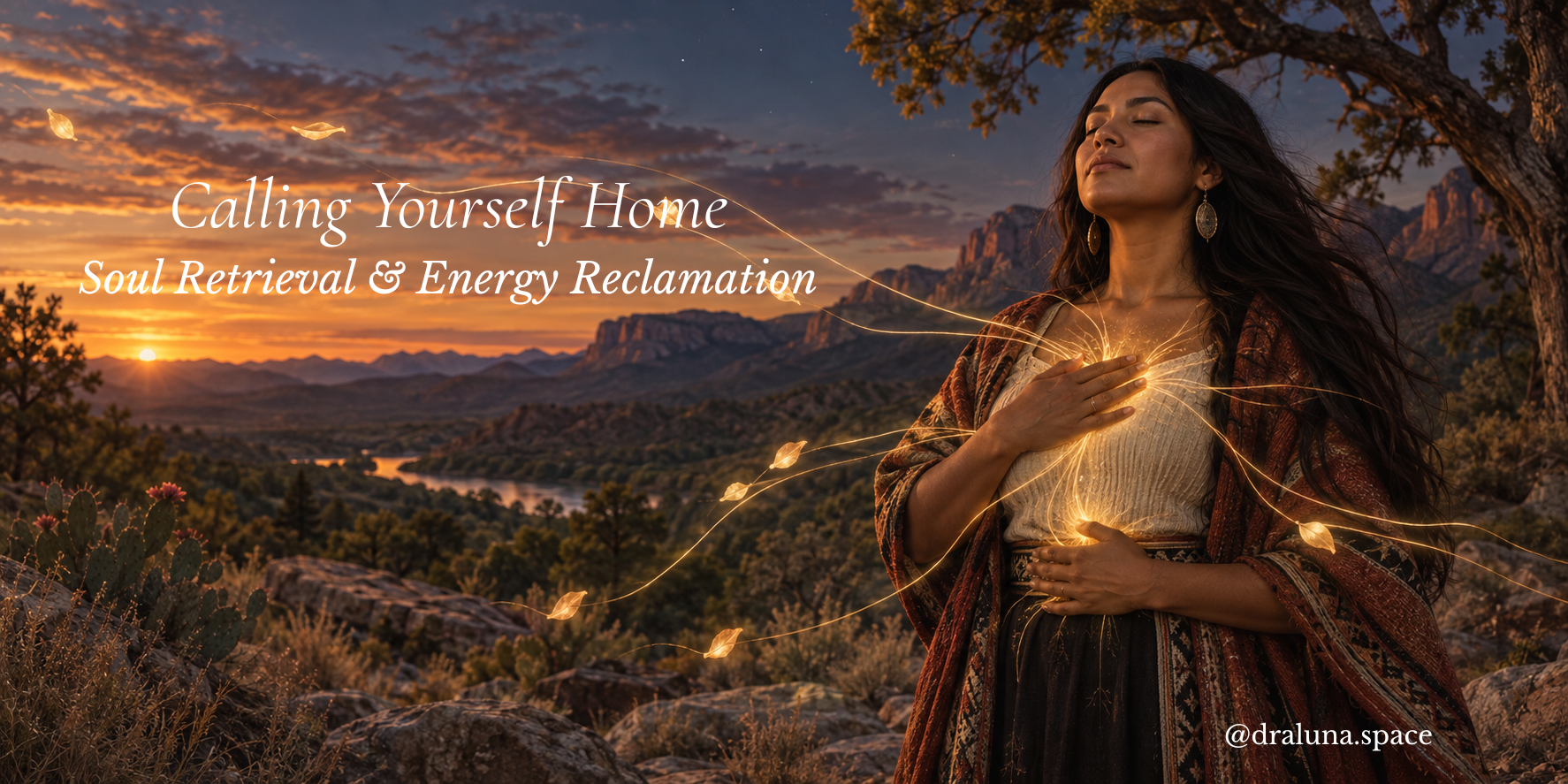
Soul Retrieval & Energy Reclamation: Holistic Wellness Services for Calling Yourself Home
Sometimes you understand the pattern but still find yourself repeating it. Soul retrieval is a sacred process of calling home the parts of yourself that became hidden, silenced, or disconnected through grief, trauma, difficult relationships, or self-abandonment.
Sometimes you know exactly what your pattern is, yet something inside you continues to repeat it.
Imagine receiving a request and immediately feeling tightness in your chest. Your body says, Not this time. But before you pause, you hear yourself say, “Of course.” You agree to help, even though you are already exhausted. Later, you feel frustrated—not only with the other person, but with yourself.
This is how self-abandonment can hide beneath generosity, loyalty, or love.
Over time, pieces of your voice, power, and life force can become tied to the places where you learned that belonging required silence, overgiving, or putting everyone else first.
Soul Retrieval & Energy Reclamation is a sacred process of calling those parts of yourself home.
Within my Holistic Wellness Services, soul retrieval may include spiritual journeying, ancestral wisdom, ritual, energy healing services, and embodied integration. We explore where your energy became connected to an old relationship, family role, survival response, or version of yourself that no longer reflects who you are.
The work does not end with retrieving a lost part. Reclamation means learning to live differently with what has returned. It may look like pausing before saying yes, honoring what your body is communicating, setting a boundary without overexplaining, or using the voice you once learned to silence.
Whether experienced in person or through online wellness services, this work is not about becoming someone new.
It is about remembering who you were before you learned to leave yourself behind—and choosing to remain with yourself now.
If this exploration of Soul Retrieval & Energy Reclamation is speaking to something within you, you are invited to explore how we might work together.
Are You Ready to Go Deeper?
Understanding the pattern is often the beginning. Embodying a different way of living may require deeper support, intentional practice, and a space where the whole of you can be seen.
Through Moon Woman Wisdom, I offer holistic coaching, spiritual wellness, energy healing, and integrative guidance for women and practitioners ready to reclaim their voice, strengthen their boundaries, and move beyond patterns that no longer serve them.
Why Sovereignty?
I’ve been contemplating the topic of sovereignty lately and asking myself: Why does it feel so important right now?
And then another question came to me:
Hasn’t it always been important?
Don’t we all want the freedom to be who we are? To make choices about how we live, what we believe, what we allow into our lives, and what we choose to leave behind?
I imagine most of us would say yes.
But when we look a little deeper, another question emerges:
How much of what we choose is actually ours?
How much of the way we think, behave, love, work, relate, give, sacrifice, succeed, or struggle has been shaped by something we inherited?
Family.
Culture.
Religion.
Trauma.
Expectations.
Survival.
The experiences of our ancestors.
The world we were born into.
We may technically have the freedom to choose, but that doesn’t necessarily mean we are choosing consciously—or choosing in alignment with what is true for us.
That is where sovereignty becomes much more interesting to me.
Sovereignty is not control
My relationship with this question probably began when I was a child.
I wanted to have control over my own life, but children simply don’t have that kind of autonomy. Our parents and caretakers make choices for us, hopefully with our wellbeing in mind.
But our parents are human too.
They are navigating their own wounds, fears, conditioning, responsibilities, relationships, and survival. Often they are making the best decisions they know how to make with the awareness and resources available to them.
And we absorb all of it.
Then adulthood arrives and suddenly we are expected to know who we are and what we want.
What direction should I go?
How should I live?
What should I believe?
What kind of relationships should I have?
What does success mean to me?
What feels right?
What is actually mine?
Much of adulthood becomes a process of discovering the answers.
For me, education became one pathway toward understanding. I have always been a lifelong learner—curious, questioning, searching for deeper truth and greater alignment.
That search has taken me through psychology, healing traditions, spiritual practice, energy work, ancestral teachings, ceremony, consciousness, and many experiences that challenged the way I understood myself and the world.
Eventually, that search brought me more deeply into the question of sovereignty.
What does it mean to become sovereign?
I don’t believe sovereignty means having complete control over everything that happens in our lives.
None of us does.
We live within interconnected systems. We depend upon communities, environments, economies, technologies, institutions, and one another.
If we turn on a faucet, for example, water arrives through an entire infrastructure most of us did not create and may know very little about.
There are countless parts of life we cannot completely control.
But there are places where we can become increasingly conscious.
We can become more aware of what we put into our bodies.
We can become more discerning about what we consume emotionally, spiritually, and mentally.
We can learn to recognize what belongs in our energetic field and what does not.
We can question beliefs that were handed to us.
We can examine patterns that have traveled through our families for generations.
We can listen differently to our bodies.
We can decide what relationships, behaviors, environments, and ways of living continue to have access to us.
And perhaps most importantly, we can learn to listen to our own truth.
That, to me, is where sovereignty begins.
The journey from the outside back inward
So much of our lives teaches us to search outside ourselves for the answer.
Who should I be?
What should I do?
What will make me acceptable?
What will make me safe?
What will make me successful?
What will make me loved?
But healing often begins when we become quiet enough to hear what is underneath all of those questions.
There is something powerful that happens when the heart begins to open—not simply emotionally, but as a place of deeper knowing.
We begin noticing where we have abandoned ourselves.
Where we learned to silence our intuition.
Where fear has been making decisions for us.
Where old wounds are still choosing our relationships.
Where ancestral patterns may still be shaping our lives.
And where something deeper inside us has been waiting to be heard.
My work has increasingly become about creating spaces where people can explore those places.
Not so that I can tell another person what their truth is.
But so they can hear it for themselves.
Opening the heart to remember
I recently had the opportunity to explore many of these ideas during my conversation with Ezequiel Reyes on the Raw Path to Awakening podcast.
We spoke about healing, lineage, identity, ancestral connection, traditional ways of knowing, and the possibility of reclaiming parts of ourselves that may have been forgotten, suppressed, or separated from us.
And underneath so much of that conversation was this same thread:
How do we come home to ourselves?
For me, healing is not simply about fixing what hurts.
It is about creating enough space inside ourselves that we can recognize what is true.
Sometimes that means tending to trauma.
Sometimes it means questioning inherited beliefs.
Sometimes it means remembering our ancestors.
Sometimes it means reconnecting with our bodies, our intuition, the earth, prayer, ceremony, or Spirit.
Sometimes it simply means becoming willing to ask:
Is the life I am living actually mine?
And then having the courage to listen to the answer.
This is the heart of much of the work I offer.
I create spaces for people to slow down, listen inward, uncover what has been shaping them, and reconnect with the deeper truth beneath the conditioning.
Because the more conscious we become of our inner world, the more choice we have in how we participate in the outer one.
That is sovereignty to me.
Not domination.
Not isolation.
Not absolute control.
But relationship with ourselves.
Discernment.
Responsibility.
Choice.
And the willingness to live in greater alignment with what our hearts already know.
My hope is that something I share—whether through a conversation, a teaching, a healing experience, or simply a question—opens a doorway.
A doorway into your own curiosity.
Your own remembering.
Your own heart.
And perhaps one small step toward living more fully as who you truly are.
If this exploration speaks to you, I invite you to listen to my conversation on the Raw Path to Awakening podcast, where we go deeper into healing, lineage, identity, and the paths that can lead us back to ourselves.

Self-Abandonment: Why You Say Yes When You Want to Say No
Self-abandonment does not always look dramatic. Sometimes it looks like being helpful, agreeable, and endlessly available—until your automatic yes begins costing you your time, energy, boundaries, and voice.
I Said Yes, But I Didn't Mean Forever
I said yes.
But I didn't mean for that yes to become a life sentence.
As a helping professional, saying yes came naturally. If I had the capacity, I believed I should help. Somewhere along the way, generosity quietly became obligation.
Many women know this pattern well.
We're often taught that being caring means being available. That saying no is selfish. That being "good" means being agreeable, accommodating, and endlessly giving. We become so practiced at meeting everyone else's needs that we stop noticing when we've stopped consulting our own.
It rarely happens all at once.
It begins with one yes.
Then another favor.
Another phone call.
Another request because you're already doing it.
Another exception because "it will only take a minute."
Until one day you look around and realize your time, your energy, and even your sense of self have slowly become organized around everyone else's priorities.
I've watched this happen in my own life—with clients, colleagues, organizations, and friendships. Not because anyone intended to harm me, but because I stopped asking myself an important question:
Do I still want to say yes?
That's the subtle danger of self-abandonment.
It isn't always dramatic.
More often, it happens quietly—one small compromise at a time.
Someone asks for your help.
Before you've even taken a full breath...
Your mouth says,
"Of course."
Only seconds later do you notice the tightness in your chest.
The heaviness in your stomach.
The fatigue that was already there before you agreed.
Your body knew.
Your awareness simply arrived too late.
From a psychological perspective, this isn't a character flaw. It's often an adaptive pattern. When we've learned that love, belonging, or safety depend on being useful, agreeable, or emotionally available, our nervous system begins answering before our conscious mind has a chance to ask, What do I actually need?
Healing begins the moment we create enough space between the request and the response to hear ourselves again.
The Hidden Pattern Beneath the Yes
For a long time, I believed that if I did not say yes, I might not be approved of. I might not be liked. I might not be seen as good, generous, or easy to work with.
During the years I was in school, I had become accustomed to saying no. I had to study. My time was limited, and my priorities were clear. But after I graduated and stepped fully into my professional role, something shifted.
My noes slowly became yeses.
I told myself I was there to serve. Was I not being paid to help? Had I not chosen a profession centered on supporting others? If I had the knowledge, the skill, or the capacity to assist, shouldn't I?
But beneath those reasonable questions was a deeper longing.
I wanted to belong.
I wanted to be accepted.
I wanted to be experienced as helpful, capable, and good.
This was not weakness. It was a place where my sense of worth had quietly become entangled with what I could provide for others.
From the outside, this pattern can look like a simple lack of boundaries. But boundaries were not the whole issue.
It was not that I did not know how to communicate. I could feel myself saying yes before I had even given myself time to consider the request. The response came quickly, almost automatically, while my actual needs remained somewhere in the background.
That is what makes self-abandonment so difficult to recognize.
It can masquerade as generosity.
It can look like professionalism, service, loyalty, or love.
But underneath, it may be an unconscious strategy for maintaining connection: be useful, be agreeable, do not disappoint, and perhaps you will remain safe, valued, and included.
I was not simply helping.
I was trying to secure belonging through helpfulness.
Eventually, that strategy cost me. It cost me time, energy, focus, and the ability to recognize when my generosity had crossed the line into abandoning myself.
Why Awareness Isn't Enough
Awareness is necessary, but not sufficient.
One of the greatest misconceptions in personal growth is believing that awareness alone creates change.
It doesn't.
Awareness is the beginning of transformation, but it is rarely the end of it.
You can recognize a pattern. You can understand where it began. You can identify the childhood experiences that shaped it. You can know exactly why you keep saying yes when you mean no.
And still...
The next request comes.
Before you've had time to pause, your mouth has already answered.
"Of course."
Your body knew before you spoke.
You felt the tightening in your chest.
The heaviness in your stomach.
The quiet voice whispering, Not this time.
But the yes came anyway.
Why?
Because deeply rooted patterns are not sustained by conscious thought alone. Over time, they become embodied. The brain and nervous system learn which responses have historically preserved connection, belonging, approval, or safety. Eventually, those responses become automatic. Your body responds before your conscious mind has the opportunity to choose.
This is why insight alone is often not enough.
Knowing you should set a boundary is not the same as feeling safe enough to set one.
Knowing you deserve to speak your truth is not the same as having a nervous system that believes speaking your truth is safe.
Women have already read the books. They know they should pause, say no, ask for what they need, or stop people-pleasing. Yet when the moment arrives, the old pattern quietly takes over.
When the body signals that something isn't right, we often override it. We call it professionalism. Compassion. Loyalty. Being a good friend. Being a good partner. Being a good daughter.
Eventually, we become so accustomed to overriding ourselves that the discomfort feels normal.
From a psychological perspective, these patterns are adaptive survival strategies. They once helped us maintain connection, navigate relationships, or avoid emotional pain. They were intelligent responses to the environments in which they developed.
Many Indigenous and shamanic traditions describe a similar experience through a different lens. Rather than speaking only of conditioned behavior, they speak of remembering—returning to relationship with the body, spirit, intuition, and one's original nature.
I have found wisdom in both perspectives.
One helps us understand how the pattern formed.
The other reminds us what we are returning to.
This is where my work begins.
Not by giving women more information—they usually have plenty of that already.
But by helping them create enough internal safety to interrupt the pattern in real time, so that their next response comes from conscious choice rather than unconscious survival.
Because awareness may open the door.
Safety is what allows you to walk through it.
The Deeper Roots
The body is a messenger.
It is constantly gathering information, interpreting what is happening around us, and attempting to keep us safe. Long before the conscious mind has formed a complete thought, the nervous system may already be preparing us to fight, flee, freeze, submit, or appease.
We cannot always think our way out of these responses because they do not begin as conscious decisions.
They begin as adaptations.
Our upbringing, family systems, culture, and social conditioning help determine what the body learns to interpret as safe. Many women were conditioned to remain agreeable, helpful, and in service to others—regardless of the personal cost.
I learned to stay quiet.
Stay still.
Be good.
Do not disrupt anyone.
I became very good at it.
But silence does not eliminate what the body is carrying. It simply pushes it beneath the surface.
During periods of intense stress in adolescence and adulthood, my nervous system would become overwhelmed. I sometimes said or did things that I would not have consciously chosen from a grounded state. My reactions felt faster and more powerful than my ability to interrupt them.
At times, I could almost watch myself responding.
I knew what was happening.
I understood the psychological concepts.
I had studied trauma, behavior, development, and the unconscious for years.
But could I stop the response simply because I understood it?
No.
That was one of the most humbling realizations of my life.
There were moments when I felt separated from my own behavior—aware of what I was doing, yet unable to access the part of me that could choose differently. My nervous system had entered survival mode, and the survival response was temporarily louder than my conscious intention.
This is how deeply conditioned patterns can operate.
They do not always feel like choices.
They feel automatic.
The same thing can happen with self-abandonment.
You say yes because helpfulness once protected connection.
You become over-responsible because managing everyone else once created a sense of stability.
You stay quiet because speaking up once carried consequences.
You anticipate other people’s needs because your body learned that vigilance was safer than uncertainty.
These strategies may begin as intelligent adaptations. But when they continue long after the original circumstances have passed, they can keep us living according to an old map of danger.
For me, change did not come from gathering more information.
It came through unraveling what lived beneath the information.
Through ceremony, shamanic practice, and deeper exploration of the unconscious and subconscious layers of my psyche, I began uncovering what had kept my body organized around survival. Some of what I encountered came from my own experiences. Other patterns seemed older—woven through family roles, inherited grief, ancestral survival, and ways of being passed from one generation to the next.
We inherit more than physical traits.
We may also inherit family expectations, emotional responsibilities, silence, fear, unresolved grief, and strategies for surviving environments we never personally experienced.
This does not mean we are powerless.
It means the pattern may have roots deeper than the present moment.
That is the hard part.
And it is also why I do the work I do.
My approach brings together nervous system awareness, psychological understanding, unconscious conditioning, inherited family patterns, and ancestral healing. Not because every struggle must be made mystical, but because some patterns cannot be fully understood by examining only what is visible on the surface.
Sometimes the present-day behavior is only the messenger.
The deeper work is discovering what the body has been trying to protect—and helping it understand that it no longer has to live there.
A Simple Practice
Staying present with what is happening is important.
We may begin to recognize that we are caught in a cycle—one that keeps us responding in ways we no longer want. But once we notice the pattern, what can we actually do in the moment?
One breath will not undo years of conditioning.
But one breath can create space.
The practice is learning to feel yourself breathing and noticing when your body begins speaking to you. Before answering a request, pause long enough to feel what is happening inside.
Take a breath.
Then ask:
What is true for me?
Is agreeing to this request truly in my highest and best good?
Do I genuinely have the capacity to say yes?
Am I choosing this freely, or am I responding from guilt, obligation, fear, or the need to be approved of?
Does this yes feel flexible—or does it already feel like a life sentence?
The purpose of the pause is not to force an immediate answer. It is to give yourself permission to notice the deeper meaning beneath your response.
Perhaps your chest tightens.
Perhaps your stomach drops.
Perhaps you feel a rush of urgency, as though you must answer immediately.
Perhaps you already know the answer is no, but you are afraid of what the other person may feel.
All of that is information.
The next part of the practice is learning to say no—and noticing how your body responds when you do.
Does your heart race?
Do you feel guilty?
Do you immediately want to explain, soften, apologize, or reverse your decision?
Do you fear that the relationship will change?
These reactions reveal where you may still be placing your value in someone else’s approval rather than in your own truth.
The practice is simple.
It is not always easy.
One breath at a time, you begin making space between the request and the response.
That may mean not answering immediately.
It may sound like:
“Let me think about that.”
“I need to check in with myself before I commit.”
“I’m not available for that right now.”
“I said yes earlier, but I need to change my answer.”
You are allowed to pause.
You are allowed to reconsider.
You are allowed to adjust a yes that no longer feels true.
And sometimes, when you stop abandoning yourself, other people will become disappointed, frustrated, or even angry.
That does not necessarily mean you have done something wrong.
It may simply mean the relationship had become accustomed to your automatic yes.
This is where the deeper work begins: learning to remain connected to yourself even when someone else is uncomfortable with your truth.
One breath will not heal the entire pattern.
But it may be the moment you stop leaving yourself.
An Invitation to Return to Your Voice
What if your next yes didn’t come from obligation?
What if it came from choice?
Reading can help you recognize the pattern. But as I have learned, insight alone is not always enough. The body needs a different experience—a moment of safety, breath, and permission in which your authentic voice can begin to come forward.
That is why I created Sovereign Woman: A Sacred Breath & Voice Activation Ceremony.
This 75-minute live online experience is for women who are ready to begin interrupting patterns of self-abandonment, reconnect with the body, and create space for what is true.
Together, we will move through conscious breath, nervous-system grounding, gentle sound, and voice activation—not to perform or sing perfectly, but to listen beneath the automatic yes and allow your authentic expression to emerge from a more grounded and sovereign place.
If this article named something you have been living, I invite you to experience the next step—not through more information, but through breath, sound, embodiment, and sacred practice.
Monday, July 27, 2026
6:00–7:15 PM Pacific · Live Online
Sacred Exchange: $33
A Final Thought
Healing is not the absence of fear.
Sovereignty is not the absence of discomfort.
It is the willingness to remain connected to yourself—even when your old patterns invite you to leave.
You don't have to do it perfectly.
You don't have to figure it all out today.
You simply have to begin noticing the moments when your body is asking you to pause, to listen, and to choose yourself with honesty and compassion.
Because every time you choose to remain with yourself instead of abandoning yourself, you are rewriting a story that may have been carried for years—perhaps even generations.
And perhaps...
that is where every true journey home begins.
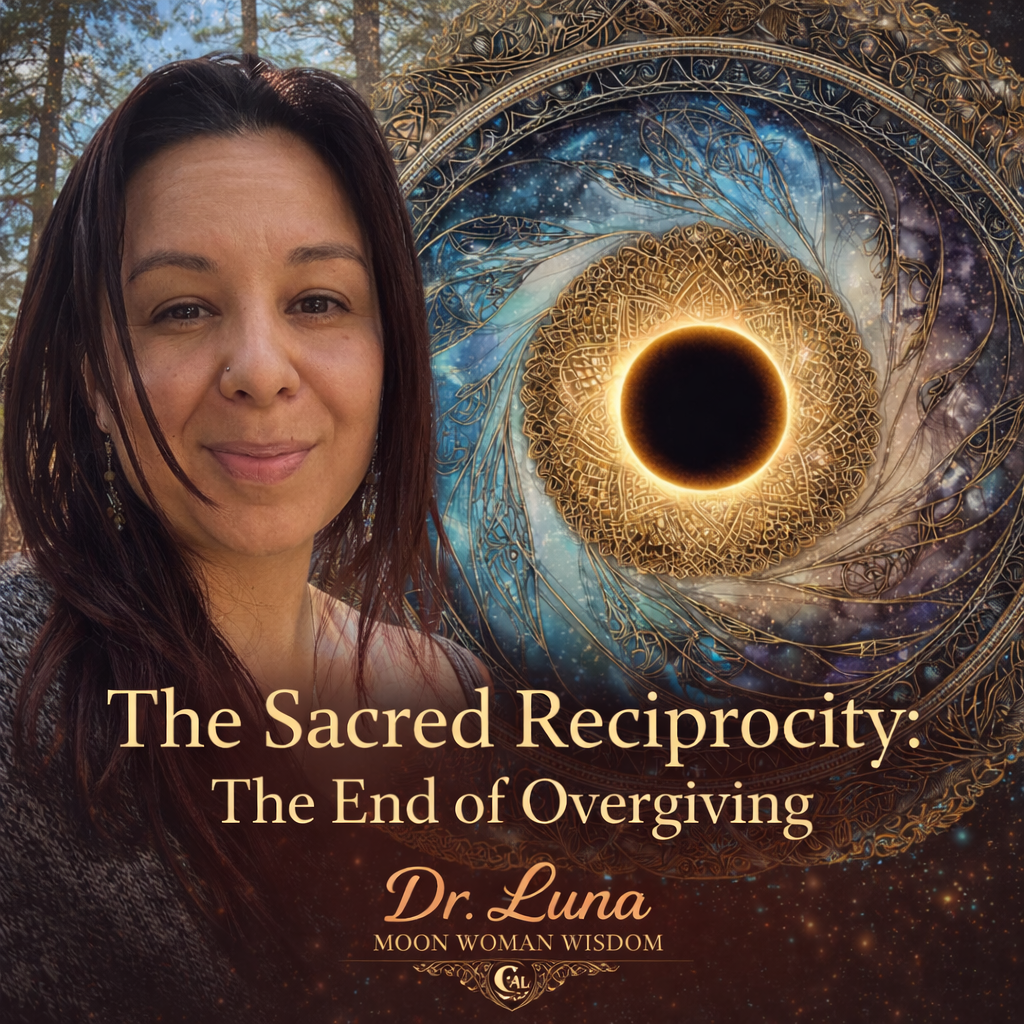
Sacred Reciprocity: The End of Overgiving
This is why overgiving is hurting you—and why it has to stop.
There comes a moment when giving stops feeling generous…
and starts feeling like depletion.
You’re still showing up.
Still supporting.
Still holding everything together.
But something in you is tired.
Not just physically—
deeply. In the bones kinda tired.
Many women know this place intimately—
the quiet exhaustion of always being the one others rely on…
while no one quite holds you the same way.
But overgiving is not just kindness.
It is conditioning.
At its root, overgiving often comes from a nervous system that learned early on:
approval equals safety.
If you are needed, you are safe.
If you are giving, you are loved.
If you are accommodating, you belong.
This is the voice of the Self-Doubter—or dare I say the imposter?
The part of you that believes love must be earned through self-sacrifice.
And so you give.
You stretch.
You override your needs to maintain connection.
Until one day, without realizing it,
you’ve entered into a silent agreement:
I will keep pouring… even if no one pours back.
From Extraction to Kinship
Sacred reciprocity offers a different way.
In earth-based and Indigenous ways of knowing,
life is not built on extraction—
it is built on relationship.
Nothing is meant to give endlessly without receiving.
But when you overgive,
you begin to treat your own body and energy
as if they are infinite resources.
They are not.
You are not a well to be emptied.
You are part of a living system.
And every living system requires balance.
Sacred reciprocity is the remembering that
you are not separate from the web of life—
you are within it.
And within that web,
energy must move both ways.
Just as the Earth nourishes and asks to be tended,
your spirit requires the same.
The Return to Sovereignty
Choosing reciprocity is not selfish.
It is stewardship.
Your body.
Your breath.
Your energy.
These are not things to give away freely without awareness—
they are things entrusted to your care.
And when you release the inherited belief
that love requires self-abandonment,
everything begins to shift.
You stop performing your worth.
You start honoring your truth.
This is where the Sovereign Woman emerges.
She does not abandon herself to be chosen.
She chooses herself—and from that place, she gives.
Not from depletion.
But from overflow.
And just as importantly—
she allows herself to receive.
Sacred reciprocity is the end of holding everything alone.
It is the beginning of being held, too.
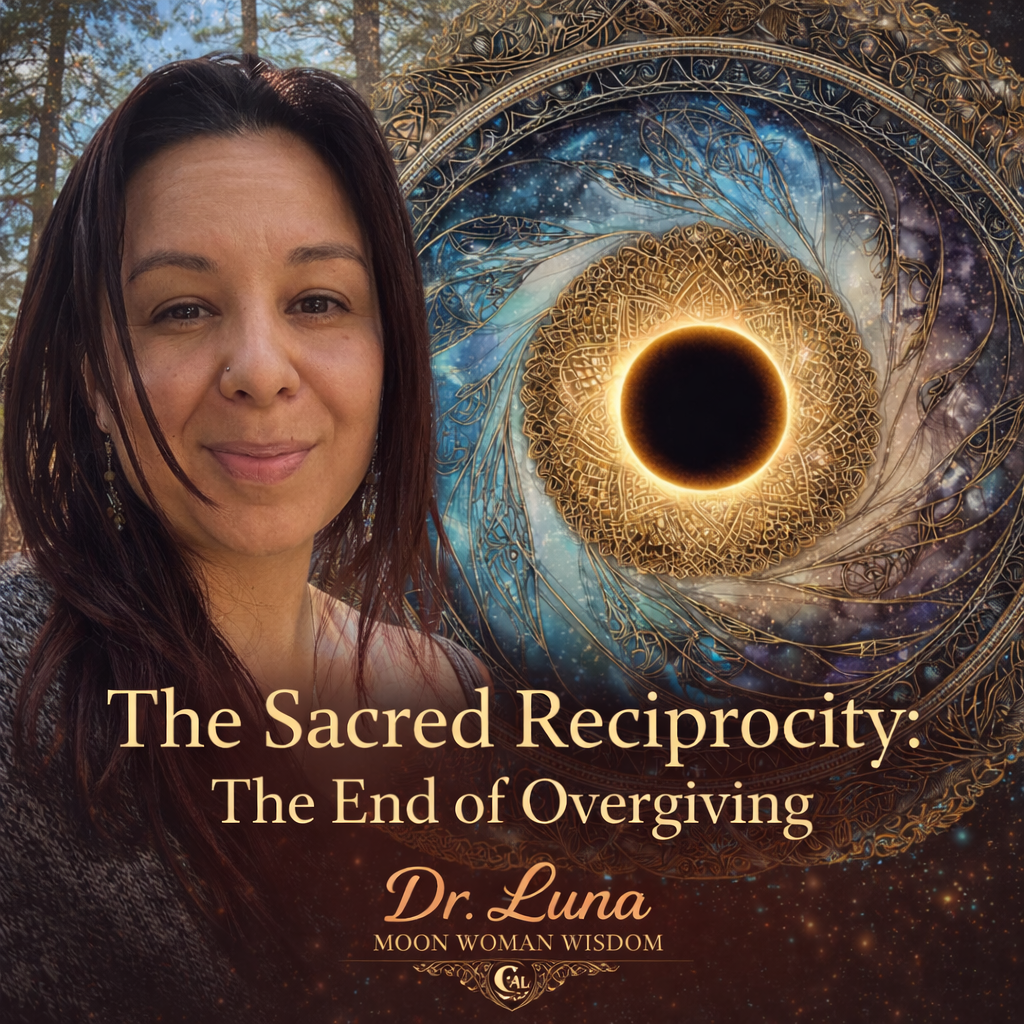
Dr. Luna & A Sacred Reciprocity Symbol

When Digestion Breaks Down, It’s Not Just About Food
What my body taught me about stress, rhythm, and learning how to listen
My journey with food as medicine didn’t begin with inspiration.
It began in the middle of a high-stress season—my doctoral program—when I realized I could no longer eat without discomfort.
Not sharp or acute, but constant.
Bloating. Heaviness. A lingering sense that nothing was really digesting.
At the time, I couldn’t pinpoint when it started.
Looking back, I can see it wasn’t sudden.
It was a slow progression—signals my body had been sending long before I knew how to listen.
So I started trying to fix it the only way I knew how.
I stopped eating meat, convinced it was the problem.
When that didn’t change much, I cut out bread.
But even then… nothing fully shifted.
It felt like no matter what I ate, my body couldn’t process it.
And underneath that, something quieter was happening—
I wasn’t digesting my life very well either.
The pace, the pressure, what I was holding myself to…
none of it was really settling.
Eventually, I found my way to a Traditional Chinese Medicine practitioner.
After a simple muscle test, he told me: no wheat, no gluten, no dairy.
It felt extreme. Confusing, even—especially at a time when gluten wasn’t widely part of the conversation.
But I followed the guidance.
And slowly, I began to feel better.
That was my first realization:
something I had been eating every day wasn’t actually supporting me.
And still—I knew that wasn’t the whole picture.
It took years for that understanding to deepen.
Through two yoga teacher trainings, an Ayurvedic counseling program, and a gradual return to listening, I began to see more clearly what had been happening.
Not that I had done something wrong.
But that I had never been taught how to be in relationship with food.
How to support digestion.
How to eat in rhythm with my body.
How to adjust with the seasons—both internally and externally.
I wasn’t disconnected because I failed.
I was disconnected because no one had shown me another way.
Today, I hold food differently.
Not as something to control or perfect,
but as something to listen through.
It’s not about eating “right” all the time.
It’s about noticing:
What season am I in?
What is my body asking for today?
What actually supports digestion—not just consumption?
Ayurveda offered me a framework for this.
Not as a set of rigid rules,
but as a way of living in relationship—with nature, and with my own internal landscape.
Not perfectly.
But with awareness.
If your body has been asking for something different—
if food feels confusing, restrictive, or disconnected—
this is the work I hold now.
Through Ayurvedic counseling, we look at your unique constitution, your digestion, your patterns, and your rhythms—
and begin to translate what your body has been communicating.
Not through rules.
But through awareness, and alignment.
If that resonates, you’re invited.
Follow the link below to schedule your Ayurvedic Counseling Intake at Sevanti Wellness.
The Sacred Pause Before Sovereignty
There’s a moment you’ve reached…
Where you know—
you cannot keep going like this.
Not because you haven’t tried.
But because you’ve tried everything.
You’ve done the work.
You’ve invested.
You’ve shown up.
You’ve pushed yourself to grow, to heal, to evolve.
And still…
Something isn’t landing.
Something still feels off.
Disconnected.
Unsettled in your own body.
And you’re done apologizing for it.
Done making yourself wrong.
Done pretending you’re “almost there.”
Because deep down, you know:
This isn’t about doing more.
This Is the Moment Most Women Misread
Right here—this space you’re in—
Where things feel quiet…
unclear…
like the momentum you once had has disappeared…
This is where most women panic.
They think they’re regressing.
That they’ve lost something.
That they need to fix it—fast.
So they override themselves. Again.
They go back to performing.
Back to proving.
Back to abandoning their own body just to feel movement.
But you’re not there anymore.
You can’t go back to that.
What You’re Actually In
You’re in a Sacred Pause.
Not because you’re stuck—
But because something deeper is trying to come online.
Your body is no longer available for the old way.
The overgiving.
The overthinking.
The constant reaching.
Your system is asking for something else now:
Truth.
Grounding.
Sovereignty.
And that requires a different kind of movement.
Not force.
Presence.
This Is Where Sovereignty Begins
Sovereignty doesn’t begin when everything is clear.
It begins right here—
In the moment where you choose:
Not to override.
Not to rush.
Not to abandon yourself just to feel in control again.
But to stay.
To listen.
To return to your body… even when it’s uncomfortable.
Because you know:
If you keep going the way you were—
you’ll keep getting the same result.
And you’re no longer available for that.
This is the threshold.
The moment where you stop trying to fix yourself—
and start leading yourself.
I’m holding a space for this:
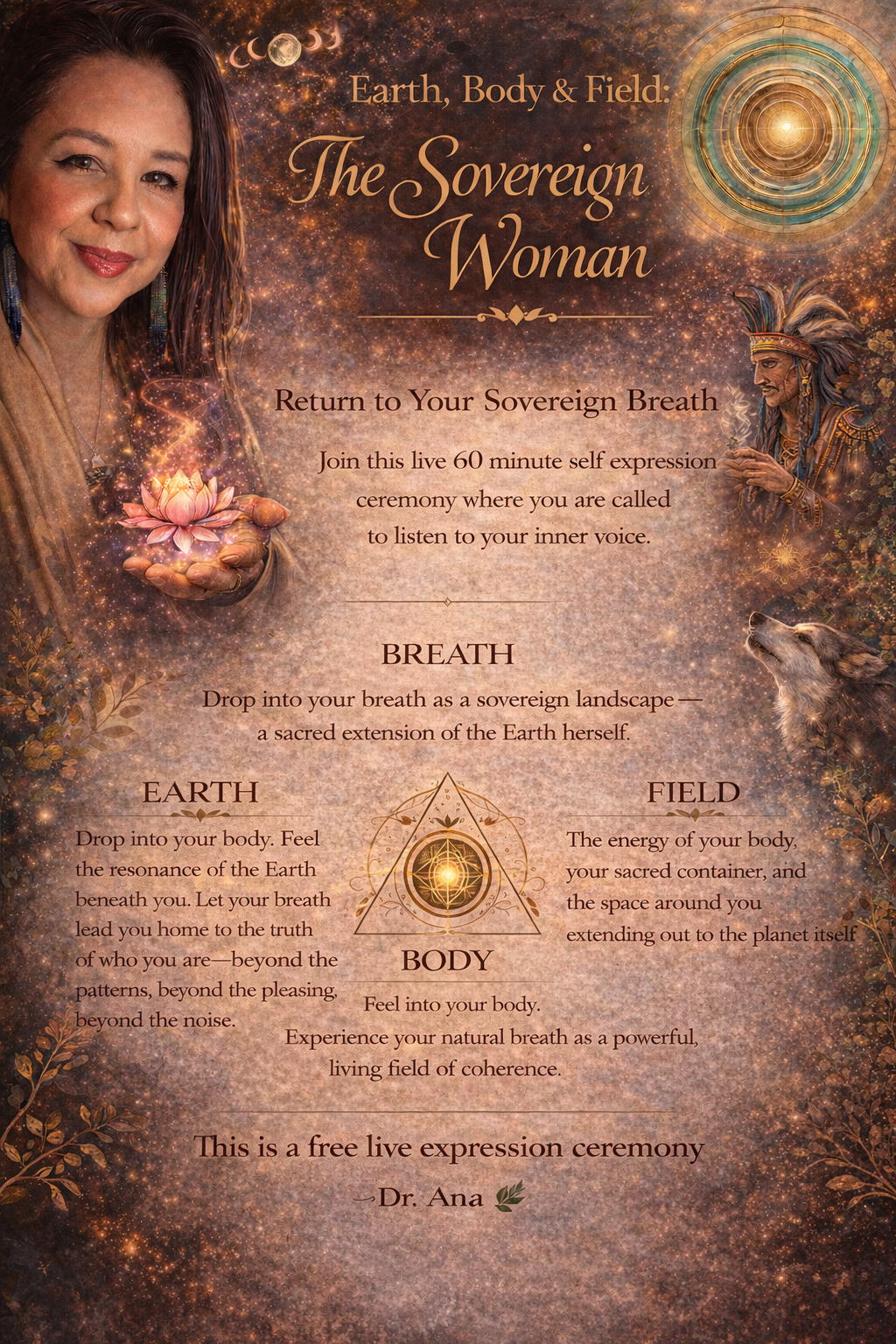
Earth, Body & Field: The Sovereign Woman
For the woman who has tried everything…
and is finally ready to do this differently.
Not from force.
Not from performance.
But from embodied truth.
If you feel this, you already know.
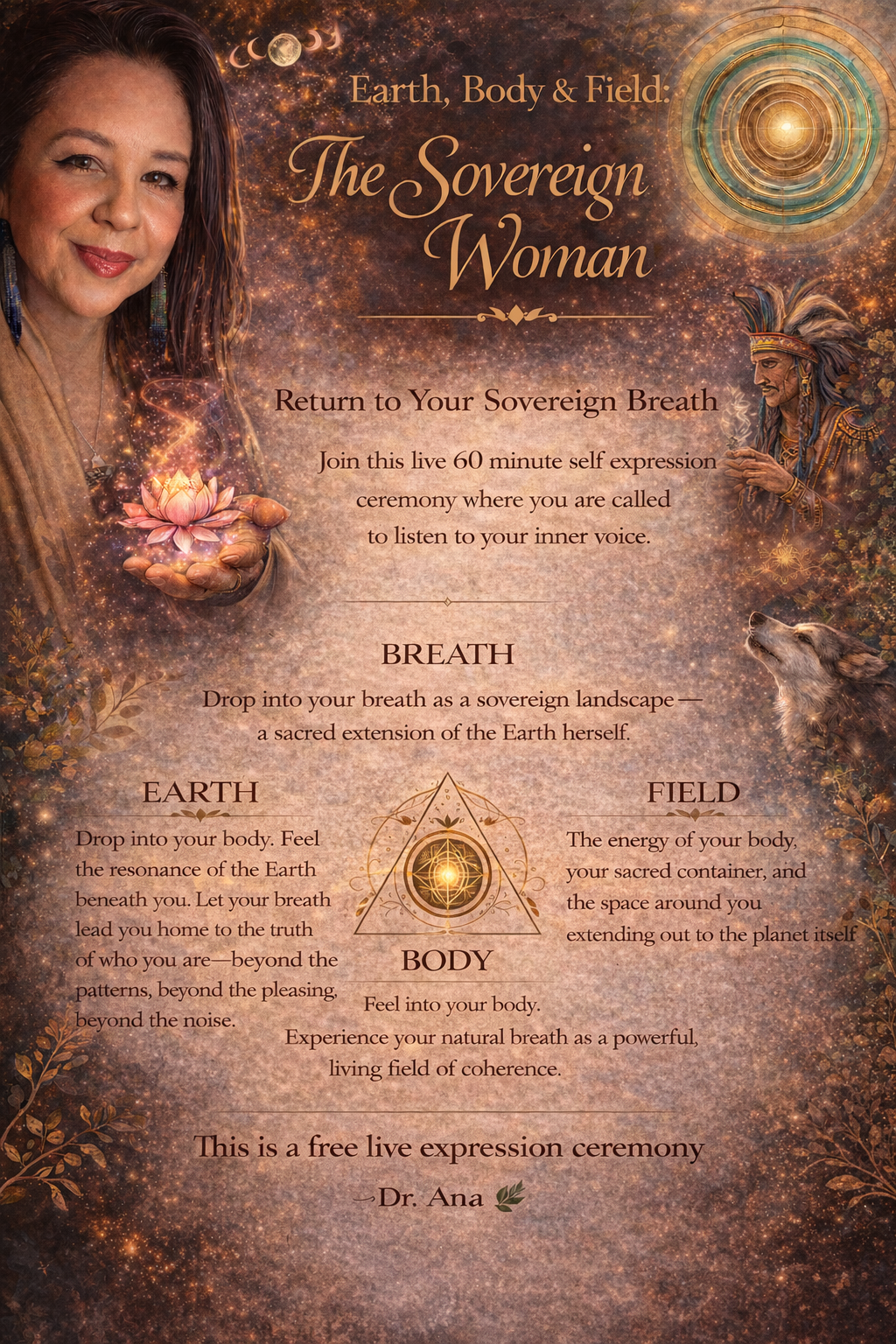
Earth, Body & Field: The Sovereign Woman
Returning to the Breath of Remembrance.
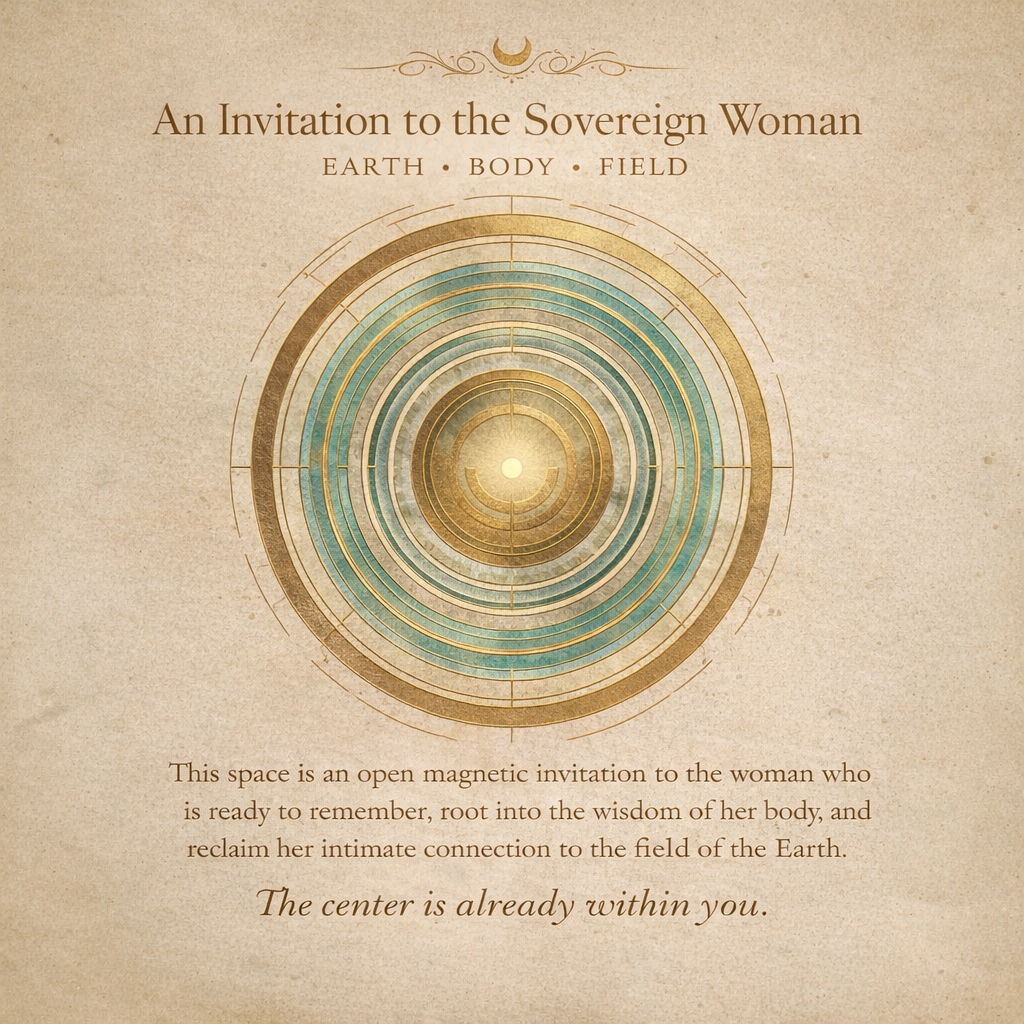
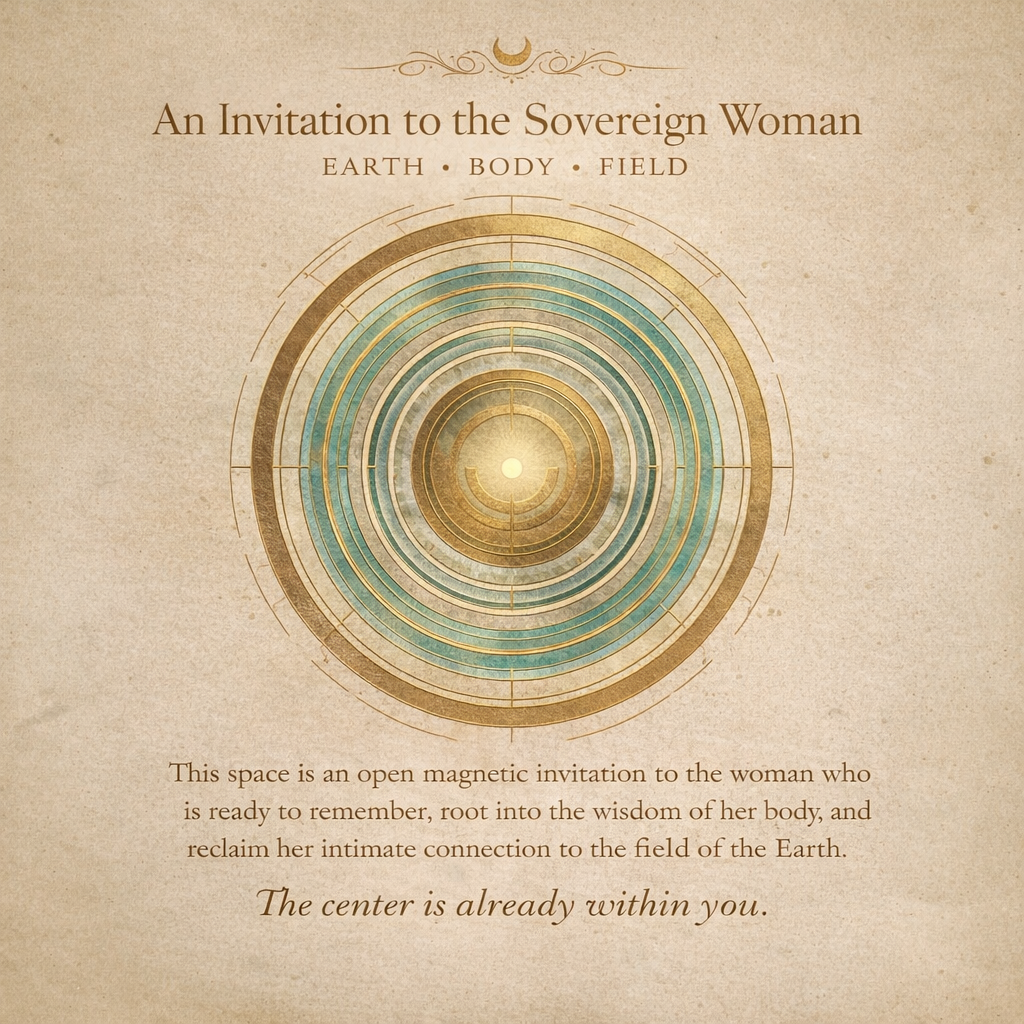
The center is already within you. The Sovereign Woman.
This winter, I entered a season of deep contemplation.
I anchored my breath into a new space in Northern California—
sitting with the stillness of the land,
allowing myself to stabilize after years of being on the road.
I let myself take a long exhale.
Listening to the breath of my body.
Listening for what was being asked of me now.
What I found surprised me.
I realized I had been so deeply in service
that I had lost touch with parts of myself.
And more than that—
I saw how easily it happens.
In between breaths.
In between decisions.
In between doing what we believe is the next right thing.
So quietly, we drift.
Earth, Body & Field is an invitation to return.
To coherence.
To the place within you that has never been lost.
Shadow & Sovereignty
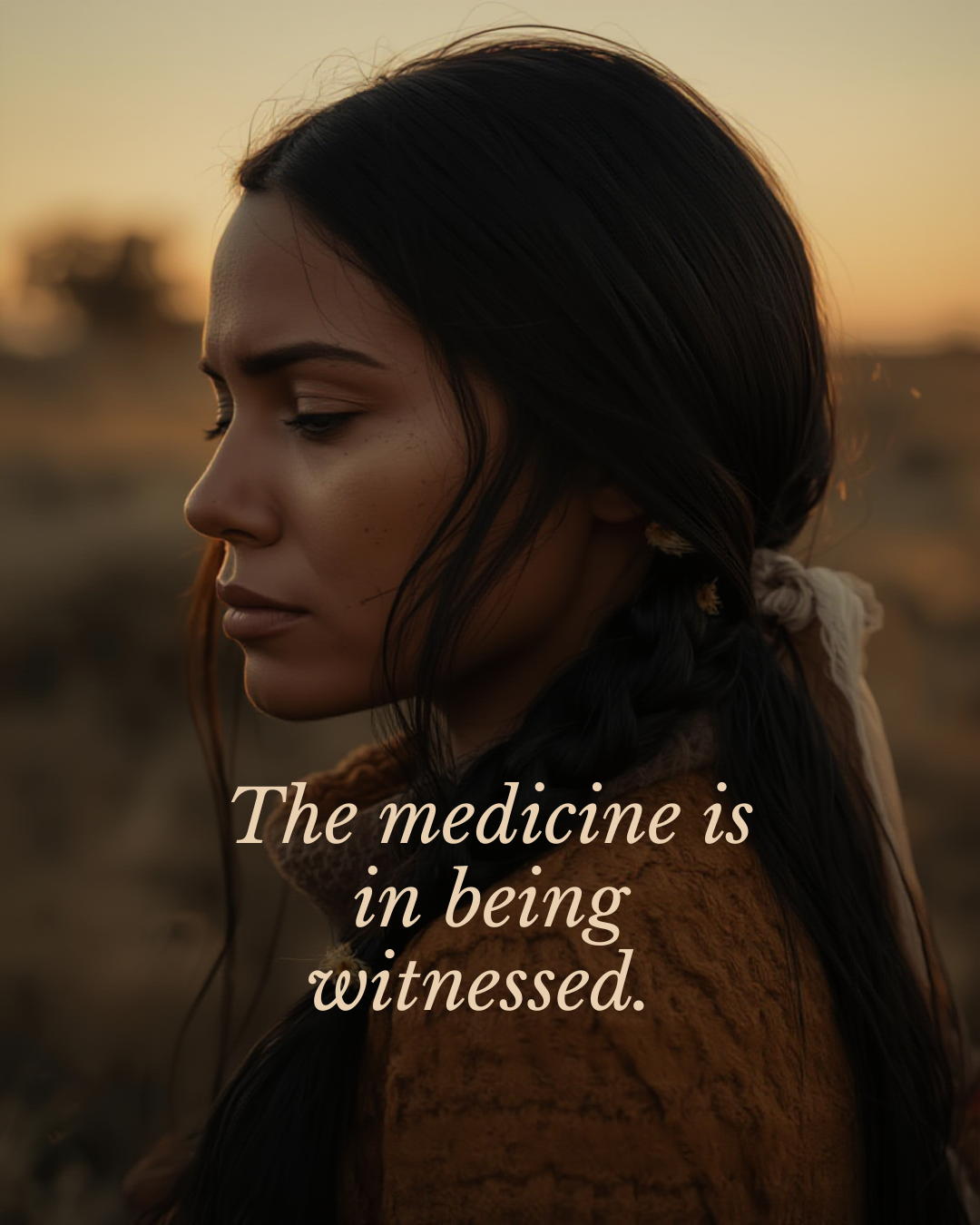
There’s a balance we are harmonizing right now. A code we are anchoring into Mother Earth to help us remember who we are. It’s not exactly rainbows and flowers. Those of us here at this time, are called to set forth this powerful work. In the process, we are pushed and pulled and kneaded in a way; we are guided into deep divine remembrance. How this looks, is what we are seeing. The divisions are present. The distractions are predominant. Our sacred walk is to stay united as we are challenged to fragment.
Perhaps the pieces of us that are fragmenting, are the ones we no longer need to keep, the shadows, the heavy dense energies; and what we are calling back to us, are the original blueprints we were always meant to have, our sovereignty, our Sacred Sovereign Self.
If you are feeling overwhelmed by the fragmentations, notice that—honor it—and gently bring your divine memories back to you—
I call all divine memories, all soul pieces, all parts of me—from all timelines, all spaces, all realities—I call you home into my sacred heart. May we come together in unity and peace. May we ponder in peace. May we live with ease. May we learn how to walk softly on this Earth.
For classes and private sessions, please connect with me at lunasolreiki@gmail.com

Cihuacóatl Rising: Calling on the Warrior Mother in a Time of Displacement
We are living through a time when Indigenous and Mexican peoples of the Américas are once again being torn from the land that holds our ancestors’ bones. Families are removed from their homes by ICE agents, children taken from their parents at the border—ripped from the arms of their mothers and fathers, community members deported to places they haven’t lived since childhood or ever. The violence feels old—older than the nation-states that pretend to own this land. It echoes the first displacements under colonization, the forced removals, the fracturing of kinship networks. Our people know this wound. It lives in our bodies like a memory we never asked to inherit.
In these moments of rupture, we do not only need the comforting mother, the one who soothes us when the world breaks apart. We also need the Warrior Mother—the one who stands at the threshold with a serpent at her feet and says: You will not cross alone.
This is where Cihuacóatl returns to us.
Anzaldúa mentions her only briefly in Borderlands, but her silence leaves an opening, a space for those of us living these ruptures to understand Cihuacóatl in our own moment. Traditionally, she is a serpent-woman deity linked to birth, death, crossroads, and warrior mothers. She is not the soft maternal figure we sometimes associate with Tonantzin or Guadalupe. She is the fierce mother. The one who protects those passing through dangerous thresholds. The one who knows what it means to fight for the survival of her children.
And today, we are standing at thresholds everywhere—nepantla made literal.
On the borderlands, at detention centers, in the limbo of deportation proceedings, in the ache of separation from family and homeland. We are suspended between worlds, between identities, between the memories of where we come from and the fear of what we may lose next.
In Anzaldúa’s conocimiento, nepantla is the unstable, painful space before transformation. But she never tells us who guards us there. She gives us Coatlicue to explain the visceral shock, the darkness that tears us open—but she does not name the mother who stands at the doorway before that descent. Today, many of us feel that absence. And it is Cihuacóatl who steps forward to fill it.
Cihuacóatl is the sentinel of nepantla, the guardian of those who must cross.
She does not remove the pain—she fortifies us for it.
She walks beside those who migrate, who flee violence, who are forced to start over.
She stands with families torn apart.
She bears witness when the state tries to uproot us from our homelands yet again.
Where Coatlalopeuh–Tonantzin nurtures and anchors us in ancestral belonging, Cihuacóatl gives us the strength to face injustice head-on. These are not rival energies; they are different faces of the serpent mother. Tonantzin holds us. Cihuacóatl defends us. Both are needed now.
As Indigenous people of the Américas—as people whose histories stretch across these continents long before borders—we are experiencing a collective Coatlicue moment. A moment of rupture so deep it shakes identity, family, and spirit. But before Coatlicue’s darkness takes hold, Cihuacóatl is the one who says:
I will guard you.
I will stand at the threshold.
I will walk with you as you cross this danger.
You are not alone.
In calling on her, we are not asking for miracles. We are calling upon ancestral memory, upon the strength of our warrior mothers, upon the knowledge that our survival has always depended on those who refused to let us be erased.
Cihuacóatl rises in us each time we resist displacement.
Each time we reclaim our belonging to this land.
Each time we insist that we are still here, still Indigenous, still connected to the Mother who birthed us.
In a world that keeps trying to tear us from our roots, she reminds us of a truth older than the border:
We are children of this continent.
We carry the serpent mother in our blood.
And we will not be removed again without a fight.
Amplify your Reiki Practice

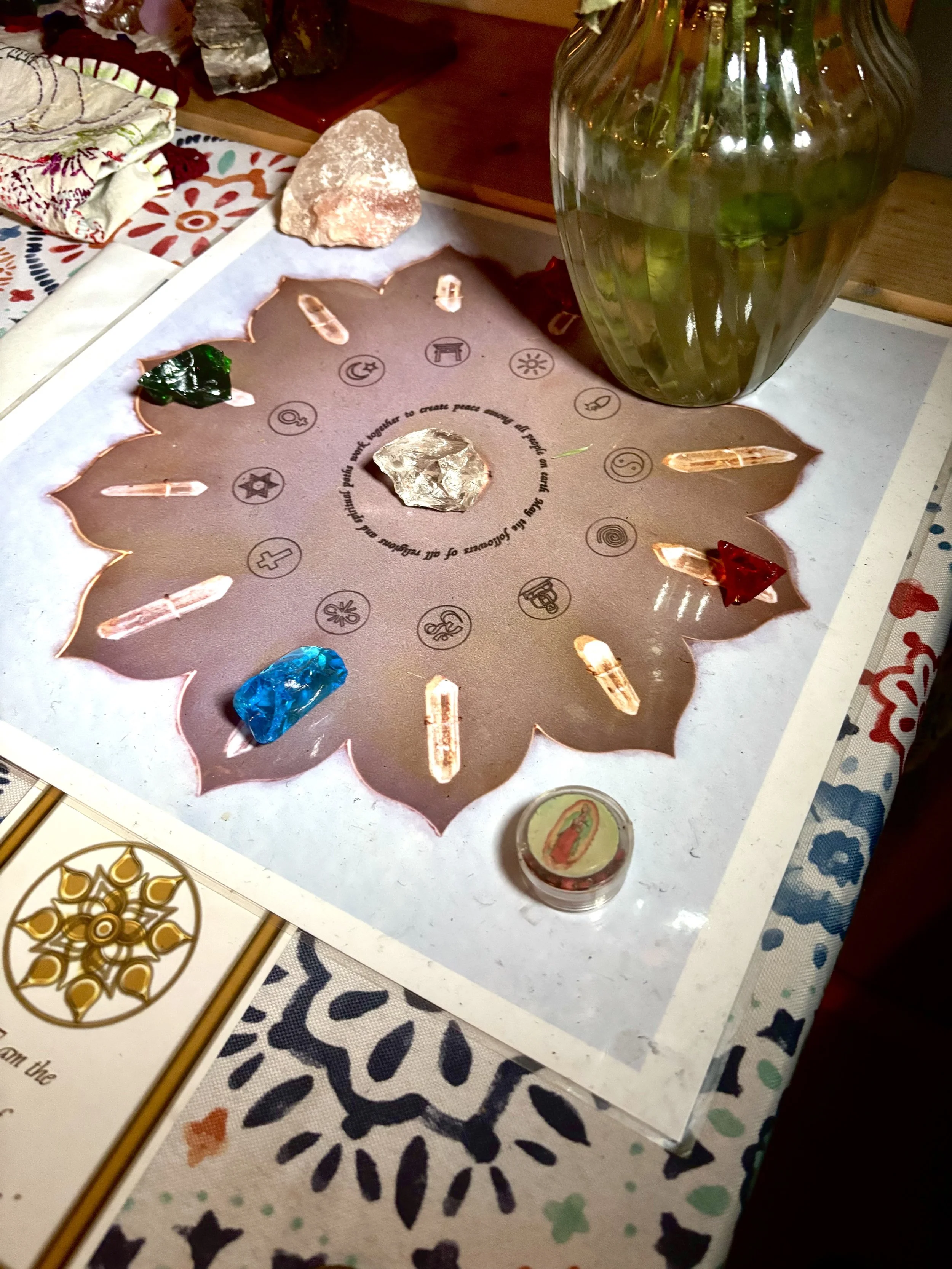
You can create an artistic, symmetrical and colorful mandala to use as your foundation for your grid.
Creating a Crystal Grid with Reiki
Creating a crystal reiki grid is easy and fun! Creating a grid is empowering, healing and allows for Reiki energy to be sent continuously even while you are not physically sending.
Whether you are working on a personal goal like changing your nutritional habits, or empowering a business idea, like a thriving Reiki practice or supporting the healing process of another person---whatever you are seeking to support, a grid will assist you and you will see and experience transformative shifts in the process.
There are many ways to approach the creation of a grid.
Questions to ask and set:
What is your intention for the grid?
Is it for a situation, individual, other, for many people/animals/situations at the same time?
Are you seeking abundance, prosperity, creativity, inspiration, optimal health?
The cool thing with a grid is it can be for all these things and more. I have one general healing grid—my reiki peace grid that I use as a base for everything else I want to do. Sometimes, I create a grid for one specific person or situation. These can be personalized for a specific client or issue you may be dealing with that needs especially charged and focused healing energy.
Setting the intention or placing a purpose for the grid is the first step in creating it.
What do you want to use it for?
Once you have an intention, let the energy guide you to connect with the energetically appropriate items for your grid.
What tools do you need to create a Crystal Grid?
Foundation: A piece of paper is the simplest-OR, you can color/create a mandala and use that as your foundation. I like to use the flower of life or similar circular and symmetrical shapes for the foundation of the grid. Anything works really, just follow your inner guidance. You can make your own or print some from online. I also like to use the Reiki Peace Grid as a foundation so I connect with the Reiki Peace Grids physically located around the globe. I have also enjoyed using this FREE crystal grid template.
. Crystal(s) or Stone(s) or a Rock(s)-_You can use as little as 1, 3, 5, 7, 8, 13 or 15 to place on your grid, whatever calls you for the specific purpose. If you choose more than 1 crystal, make sure that all your chosen stones/crystals energetically feel in balance with each other. In order to know if they are, just place them in your hands or place your hands over them, and ask if they want to work together, if you sense one doesn’t belong with the bunch—it might naturally pop out or will feel unbalanced. Trust your intuition and inner guidance. Ask yes or no questions until you find the harmonious resonance that matches your initial intention. Make sure your crystals are cleared before use and designate them for your healing crystal grid.
Make an affirmation for added Reiki flow. When I create grids, I like to create affirmation(s)/prayers and place those affirmations under the grid so I can empower the specific goals and intentions. I also like to write the names of specific persons either on the grid or on a paper under the grid or I place a cup/bowl with names on top of the grid.
I pray for all beings to receive healing light energy, Reiki and unconditional divine love, in alignment with their highest spiritual wisdom and the greater good of the collective.
May divine light and wisdom permeate in and around all beings on this Reiki grid for the highest good of all and in alignment with their highest spiritual wisdom and for the greater good and wisdom of the collective.
I invite the spiritual guidance of Reiki to illuminate the necessary healing for each of the beings on this Reiki grid. May each being receive healing in alignment with the highest good of all.
Once you have your intention, affirmations, names, foundational grid, and the crystlas or objects you will use, you are ready to put it together. I often add names or affirmations as I go along too. Don’t worry—you can change, take off, add, shift any parts of the grid as you feel inclined.
Spend a few minutes at your Reiki grid daily. Enjoy the amazing healing beneifts and the amplication your grid provides.
You may take a photo of your grid and send Reiki hwile you are away from your grid or as you feel called to empower and energize your grid with Reiki. You may wish to set it for 3 days, 10 days, 30 days or more (until that intention has completed). I often have a stable Reiki Grid that I use for multi-purposes. When I feel it’s time, I will shift or remove crystals, take it apart and start over—let your intuition flow.
Love and Light,
Ana